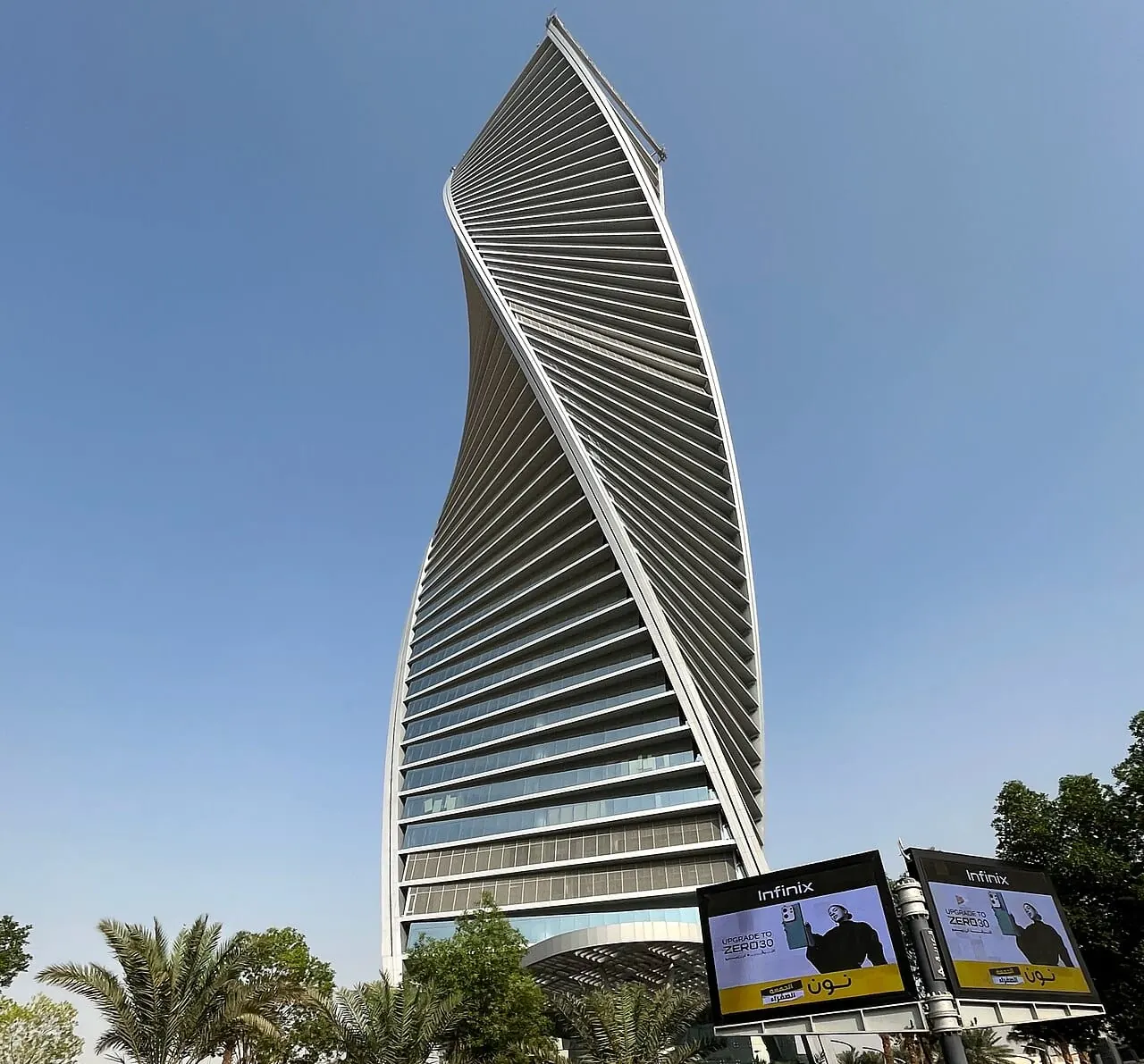
King Fahd Road is the artery around which Riyadh's skyline formed. It runs north from the city centre, and along it stands most of what people know about the capital's towers: the Kingdom Centre and Al Faisaliah in Olaya, then the office and bank towers, and further north Burj Rafal, Al Majdoul and Tuwaiq Heritage Tower.
What separates this corridor from King Salman Road is maturity: the King Fahd towers are built, operating and well known, with enormous digital presence — the Kingdom Centre alone carries more than 33,000 Google reviews.
This guide ranks the corridor by height and points to its less famous side: the office buildings on the King Fahd branch road that together form the largest office market in north Riyadh.
King Fahd Road towers, ranked by height
| # | Tower | Height | Completed | Status |
|---|---|---|---|---|
| 1 | Rafal Tower | 308 m | 2014 | Completed |
| 2 | Tuwaiq Heritage Tower | 305 m | 2027 | Under construction |
| 3 | Kingdom Centre | 302 m | 2002 | Completed |
| 4 | Al Faisaliah Tower | 267 m | 2000 | Completed |
| 5 | Tamkeen Tower | 258 m | 2012 | Completed |
| 6 | Majdoul Tower | 244 m | 2019 | Completed |
| 7 | Sky Gardens by Rafal | 213 m | 2022 | Completed |
| 8 | Al Rajhi Bank Tower | 205 m | 2017 | Completed |
| 9 | Al-Anoud Tower | 155 m | 2005 | Completed |
| 10 | Burj Al Anoud 2 | 155 m | 2012 | Completed |
| 11 | Al Nakhlah Tower | Not announced | 2014 | Completed |
Al Majdoul: the twist that became a landmark
Al Majdoul is a 244-metre office tower of 54 floors whose Arabic name comes from the verb meaning to twist — a literal description of its form. The twist is produced by rotating the square floor plates 2.5 degrees at each level, giving a total helical rotation of 135 degrees from base to crown.
It was designed by Zeidler Partnership Architects for Awtad Real Estate, built between July 2012 and June 2019, and served by 24 lifts. It hosted a Riyadh Season zone in 2022 as part of the Riyadh Sky experience.
Burj Rafal: the tallest residential tower in the Kingdom
Burj Rafal in Al Sahafa stands 308 metres across roughly 70 floors, the tallest residential tower in Saudi Arabia. It opened in January 2014 with 349 hotel rooms on its lower floors and 474 apartments above, including duplexes and penthouses.
The hotel opened as Burj Rafal Hotel Kempinski before Marriott International took over management and reopened it in November 2022 as the JW Marriott Hotel Riyadh — the brand's Saudi debut. Public reviews show a notable gap between the hotel's high ratings and the lower ratings for the residential complex's management.
The less famous side: the office market on the branch road
Beyond the landmarks, the King Fahd corridor and its branch road in north Riyadh hold a whole layer of office towers and business centres known mainly to the people who work in them: Tamkeen Tower; Al Nakhlah Tower in Al Sahafa, whose directory lists major occupiers including PepsiCo and the Expenditure and Projects Efficiency Authority (ADAA); plus the SAB head office, Smart Tower, Tatweer Towers, Hital Tower and other business centres on the branch road.
This group does not top height rankings — several have no published specifications at all — but together they constitute the real supply of office space in the north of the capital, the destination companies moved to as the city extended north away from traditional Olaya.
Frequently asked questions
What is the tallest tower on King Fahd Road?
Burj Rafal at 308 metres is the tallest on the corridor, followed by Tuwaiq Heritage Tower at 305 metres and the Kingdom Centre at 302 metres.
How far does Al Majdoul Tower twist?
It twists 135 degrees from base to top, through a 2.5-degree rotation of each floor plate relative to the one below.
How do King Fahd Road and King Salman Road differ in their towers?
King Fahd Road is a mature corridor where most towers are complete and operating, and it holds Riyadh’s best-known landmarks. King Salman Road is a new corridor dominated by office towers under construction, most of which have no fully published specifications yet.